Showing posts with label Review. Show all posts

Monday, May 04, 2015

At the Water's Edge


Today I finished "At the Water's Edge". Sara Gruen, the author, also wrote "Water for Elephants", which I read not too long ago.

In this novel, set in early 1945, the main character is an American woman visiting Scotland with her husband and his best friend. Back in Philadelphia, they are socialites with more money than direction or purpose, and their trip to Scotland in the middle of World War II is more of a frolic than anything else.

They are after a sighting -- and hopefully photographic proof -- of the Loch Ness monster. This fact, coupled with their truly awe-inspiring rudeness toward everyday, working-class people, alienates the sympathy of the local populace with surprising speed.

Mild hijinks ensue and our heroine, frequently abandoned at the inn while the men go adventuring for days at a time, winds up interested in, attracted to, and understanding of the hardworking locals.

I have to admit, here, that I didn't feel captivated by this book. The conflicts seemed overly contrived, and because the villain spent so much time off-stage, I didn't feel very invested in or concerned about the threat to our heroine. I never really believed she was in any danger -- certainly none that a bit of stiff upper lip couldn't prevent.

With all its faults I preferred "Water for Elephants" to this one. Still - I'm glad I read it and it was a nice way to pass a few hours over the last week or so.

Up next -- Kazuo Ishiguro does it again!

Tuesday, December 30, 2014

Dress Shop of Dreams

The Dress Shop of Dreams: A Novel


Christmas is here, with all its spice and sleepiness. For the first time in months, I spent a few hours today reading a book: Dress Shop of Dreams, by Meena van Praag. It was a great way to pass the afternoon. It's a lovely thing like a slice of what they call 'plain cake'; simple yet sumptuous.

Dress Shop of Dreams is a sweet story about a few people who are turning in the wrong directions and need to be put right. The book has romance, clever plot turns, a little suspense, a good dose of emotion, and just a whiff of sorcery.

The dress shop really is magical, and that element of fancy, of fantasy, made the book such a pleasure to read.

Amazon tells me that Meena van Praag has written a few other books and, having enjoyed this one very much, I'll be reading the rest this year.

Thanks, Meena, for this little swirl of magic at Christmas time!

Monday, February 24, 2014

The Forever Girl, with one big huge spoiler.

Erudite Mondays at Half Soled Boots
Volume 13 Number 2

by Alexander McCall Smith


I really wanted to love this book.

In the end, I'm not even sure I like it.

This is the first Alexander McCall Smith book I have read (he of the "No. 1 Ladies' Detective Agency") so I don't know how it compares, but I was favourably impressed by his style. It has a certain distance from the reader...I didn't feel as if I was walking in their shoes, or sitting in their living rooms: I felt I was hovering over their houses, detached from the characters, their situations, and even from the passage of time. Sometimes you want to be right in the thick of the narrative, feeling what the characters feel, and sometimes you want to experience the story with a little more elegance.

It started out so well. The author announces, right on the first page, that the novel is about unrequited love. He claims to be exploring this idea that there is no "one person" to whom we are bound, and with whom, if we can only find them, we will have a complete life - will be a whole person.

90% of the novel works to support this premise. The characters circle each other in a decades-long dance of attraction and repulsion, while we await further developments. Time flies in this book: one turns a page, and find that years have passed. Over the course of the novel, the reader comes to believe that He does not love Her - this has the undeniable ring of truth and the undeniable proof of events, dialogue, even body language. All the choices the male character makes are away from the girl who loves him.

Just as one is thinking "well, that's the meaning of 'unrequited'", a curve ball arrives. Suddenly, literally on the last two or three pages of the book, the author does a complete 180, and has his annoying leading man (up until now the wishy-washiest of noncommittal losers) suddenly declare undying and forever love for the woman who has waited all this time for him to realize her existence.

What the heck?

In one fell swoop (or "foul sweep", as I see on the internet constantly), all the credibility disappears. The author's whole point, everything he has been working towards, the evidence of the reader's own experience, is chucked out in order to provide a pat happy ending.

The events of the story, the characters themselves, just don't support this conclusion. I'm left wondering whether the author had originally intended a very different ending than the one he actually wrote. Nine times out of ten, life just doesn't turn out like that: the letter doesn't get delivered in time, the prince finds someone else who fits the glass slipper, and young starry-eyed women, formerly models of constancy, get tired of waiting on balconies for their clueless, idealized lovers, and marry the grocer just so they can get on with it.

I expect this novel will do well on the shelves of local drugstores, so people can pick up a copy while they are getting sunscreen and flip flops on their way to the beach. It's just the kind of thing people like to read to distract themselves momentarily while working on their base tan, or waiting in the middle school parking lot. I know this kind of book sells well, but in my opinion the ending undermined both the novel's premise, and the reader's investment in the characters. With the Disneyfied conclusion, the whole thing became forgettable.

Reread? No.
Recommend to Others? No.
Bookplate? No.
0/3

Monday, February 03, 2014

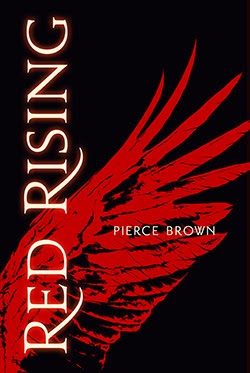
Red Rising

by Pierce Brown

Whew! This is a gritty one, as YA novels go.

The premise will be a little familiar, especially if you've read The Hunger Games, Divergent, or even the classic Ender series. It's a terrible time for mankind, some unnamed distance into the future. We've burned the planet out and have had to colonise other places in the solar system. Following the obligatory civil war, which the reader takes to be not far distant from this present moment in time, humans stratified themselves to make survival possible (based on colours - so "Red" at the bottom, the menial worker class, "Gold" at the top). The strata system proving useful to those in overlordship, it was kept long after its necessity had passed.

The Reds grind their lives away underground on Mars, mining helium to enable the terraforming of the planet before it can accept colonists from Earth. The Golds drop by every now and then to remind their labour force, primarily through bloodshed, horror, and the ruthless weight of their domination, of just Who is Boss...there's a strong whiff of President Snow and Panem, here; only without the roses and the pretences at urbanity.

So. Now we have the oppressed, the oppressors, and the middle classes who facilitate the oppression. The Reds are getting a little tired of endless backbreaking labour, the lash of their masters' whips, and the general hopelessness of their people's condition...the time is ripe for a revolt.

***SPOILERS AHEAD***

It might sound as if I'm criticising this novel, in my comparisons to The Hunger Games, specifically, and Sci Fi Young Adult genre as a whole (Ender's Game is a classic example). In fact, I absolutely loved this book. It DOES compare to the Hunger Games, inevitably, not least because there is actually a war game in which the young people - in the form of recruits to an elite academy for the ruling classes - are placed into an engineered landscape and observed as they kill each other. The novel is written in the same tense, too - the "historical present", that cliff-hanging, fast-paced, unflinching form that keeps you reading long after your contacts dry out.

Despite similarities, the subject matter is handled with much more bloodshed than in THG. I found that Suzanne Collins stopped short of the full scope of violence and mayhem that she could have unleashed, often taking a kinder, less brutal narrative path. Pierce Brown does not pull these punches. The killing starts almost at once, and continues right to the last few pages of the book. Hard decisions are made - not hard decisions like "I think I love Gale but I have to kiss Peeta to stay alive".

A few quick warnings - "Young Adult" it technically may be, but I would not have wanted to accidentally pick this up at the age of 14. It is very bloody. The violence is pretty relentless. There is (off-stage) rape, (on-stage) prostitution and sex slavery, and lots of swearing (some of it book-specific: I got very tired of that one catchword, "bloodydamn").

I got to read The Hunger Games Trilogy in one straight shot, over a single weekend. Unfortunately, now that I've devoured "Red Rising" in one sitting, I've probably got a terribly long time to wait until the next book comes out. I'll pick it up as soon as it is released - I can't wait to have more of this series.

Reread? YES
Give to Others? Yes
Bookplate? Yes
3/3

Thursday, October 03, 2013

Book Book

Well, well. It HAS been a while since I reviewed a book!

I've got two how-to's for you today. Let's tidy The Butler Speaks out of the way first, shall we?


This is a neat little book, comprising everything you need to know to make your life more serene and classy. Charles McPherson, butler to some very posh people in his day, has put a career's worth of tips and tricks into this one volume - you get to find out exactly what you're meant to do with that weird shaped fork, the correct way to clean a fridge (you're probably thinking, as I did, "There's an incorrect way?"), and just what your next party needs in order to be the event of the season. (Some very good ideas here, specifically - mostly along the lines of FOR GOD'S SAKE DON'T FUSS.)

At first glance I like it quite a lot, but I'm not sure that this book is a success, overall. It's got loads of useful information, sure, but much of it would only apply to a certain class of folks. (Hint: not our kind of class, at all: unless you're the type who makes seven figures, always sits in the back seat of your car[s], and lives far, far closer to the Atlantic than the Pacific.) He means well, but the tone is a little superior for me. It's meant to be, of course -- I'm sure others would find him perfectly amiable. I'm not the target audience for this book, though he tries to insist that his edicts are universally applicable.

HalfSoled Boots' Book Rating System:
Reread? Parts, maybe: I like his instructions for making a bed.
Give To Others? Not really.
Bookplate? No.
1/3

Oddly enough, and I never thought I'd say this: Martha Stewart does a little better in the "fix up your life" game than Charles does. Her Living the Good Long Life is more conversable, more practical and down-to-earth: altogether a more realistic collection of advice, especially for your everyday, average type of person. In this book, she is aiming at bettering the daily lives of the elderly. Of course, in her comprehensive career she has addressed herself to almost every age group: baby, child, young adult, middle-aged power earners. It's only natural that, she herself having reached her 70s, she would turn her laser beam gaze on senior citizens.

Lots of good stuff, though - small practical things like "never put anything on stairs, ever", and "if you see a wrinkle, put cream on it", along with more serious items of advice like "get a colonoscopy" and "your home is not a shrine to your children". I am not 70 (soon, though), but I found a couple of interesting tips and tricks in this book, and I use them now. (For instance I'm putting cream on my wrinkles, though I'm not sure it's helping.)

My only complaint about this book is that there is sometimes a faint whiff of taking care of business - as if this was the only demographic which had, until now, not felt the benefit of Martha's caring, if slightly obsessive, eye. It feels a little like tidying up loose ends.

I'll be hanging on to this one, though, because I like the honest and practical approach to aging. I like the idea that there are specific and concrete things that elders can do, and that we can do for our elders, to make the last decades of life more pleasant and comfortable.

Reread: Yes.
Give to Others: Likely.
Bookplate: Sure.
3/3

Tuesday, April 09, 2013

Practice Makes Perfect?

Erudite Mondays at HalfSoled Boots

Volume 12 Number 3


Just finished the most interesting book: Life After Life, by Kate Atkinson. She's the author of Behind the Scenes at the Museum, which I absolutely loved. Life After Life is just as good.


Life is full of mistakes, missed opportunities, tragedies and endings. But what if we could go back and try again, and keep trying until we get it right? The same life, every time, but with a moment of recognition, an undercurrent of caution at every crucial moment lived before? It's the snake with the tail in its mouth...the continuity and inevitability of life.

Ursula Todd is born on a February morning in 1910. The cord wrapped tightly around her neck ends her before she begins.

Ursula Todd is born on a February morning in 1910. The cord, though wrapped tightly, is cut in time to save her life which, this time, lasts a little longer.

The date of her birth never changes, but the date of her death is different almost every time.

This book is about more than reincarnation, though: it's about the complicated beauty of family. It's about selflessness, and the gradual awakening toward a larger purpose. The author does something very subtle, very clever with the reader's emotions. I was halfway through the book before I realized that my feelings of anxiety, frustration, doom and perplexity were not simply an independent response - were in fact engineered by her. By the end, I could only marvel at how deftly she turned me into Ursula Todd herself: I didn't so much identify with her, as I took on her experience as my own.

I am crazy about this book. I was sorry when it ended (or did it?), and will be recommending it to everyone.


HSB Book Rating:
Reread? Yes.
Give to Others? Yes.
Bookplate? Yes!

3/3

Saturday, March 23, 2013

Nigellissima!


Everybody knows I love Nigella Lawson. I have her new book, Nigellissima, her tribute to Italian food. It's a great book - lots of flexible options and "inspired by"-type dishes.

I haven't read it quite cover to cover, but nearly. I sat on the sofa the other night with a huge glass of Shiraz, flipping through the recipes, and wishing I could make her macaroni and cheese without having to get up and walk into the kitchen. The book, like all her other ones, makes me feel languid and decadent.

Nigella's books are usually hefty, filled to the brim with delicious recipes and chatty notes. Nigellissima, however, is uncharacteristically slender and understated. Much like Nigella herself, if the internet is to be believed. I'm hoping she doesn't go whittling herself even further - she looks great, of course, but I don't trust thin cooks. The thing I've always loved about her was her sublime unconcern with her weight, and her perfect - neither defiant nor apologetic - acceptance of her luscious figure. "Bosomy and bottomy", to use her words. If her next book is a volume of slenderizing recipes involving things like flax and steamed skinless chicken breasts, she will get a strongly-worded letter from me.

I've made two dinners from this book so far. One was a finger-licking, chin-dribbling feast of "chicken under a brick" - or 'bricken', as I'm calling it. This was unbelievably, smoothly, voluptuously delicious (my fingers just typed "volumptuously" twice, and I liked it both times). It's a whole chicken, spatchchocked (cut through the backbone and laid flat on a baking sheet), marinated in various spices and unguents (I have a small jar of preserved, salted lemons that really came into its own here), and then roasted hot and fast under a foil-wrapped brick. Shockingly good: the only thing I had to complain about is that the damn brick put paid to the Bakelite handle on my saute pan, which I unthinkingly used to lift the whole shebang out of the oven. It was just a few pounds too much, I guess, although my husband pointed out that now, at least, the pan fits into the dishwasher a lot better.

The second meal was a true feast. It was a whole leg of lamb, deboned, butterflied, and dressed with balsamic vinegar, olive oil, slivered garlic, sea salt, bay and rosemary (my addition). It, too, had a hot, fast roast (425 for about a half hour) and a fair bit of resting time. The only problem with THIS meal was that I didn't have enough people around my table to do justice to a whole leg of lamb. Mmm, delicious.

My favourite thing about the book is the way Nigella does NOT use a bunch of chi chi Italian names for the dishes. She uses good old English, which keeps the confusion to a minimum.

The low-down:
- LOTS of meat dishes in this book.
- And a LOT of seafood. Yerch. I am allergic to shellfish and I will end up cruising right on by huge sections
- Delicious-looking desserts
- Nigella's comfy, confidential food-writing turns up in spades and makes the whole thing worthwhile. 

My score - 4 out of 5. And to be fair I'm only deducting a star because a) there is way too much shellfish, which is less Nigella's problem than Italy's problem; and b) Nigella has gone a bit diet-ey.

Mangia!

Monday, January 07, 2013

"This shooow goes ever on and on..."

I went to see "The Hobbit". And I nearly fell out of my seat.

From boredom.

And irritation.

THE GOOD:

  • THE DWARVES. I liked everything about them. Good casting, good dialogue, good costumes, good jokes. And that "to find our old forgotten gold" song was a great fireside moment. 
  • BILBO. The perfect mix of deference and humour, reluctance and courage. Well acted and well-cast...but then I love Martin Freeman in anything. (Dent Arthur Dent) And... 
  • RICHARD ARMITAGE. I could watch him get a filling done, that's how interesting he is to me. Although it's a little disconcerting finding myself physically attracted to Thorin Oakenshield, who I've always loathed. 
  • THE KNITTING. Oh, the knitting. The dwarves are covered in the stuff, and it's all dreamy and so very, very copyable. 

THE BAD: Where to begin? Where, oh where, oh where to begin. All right, let's begin with:

  • GALADRIEL. I love Cate Blanchet, but Galadriel's stupid faux-sonorous voice, with that ridiculous habit of unnecessary telepathy, has got to stop. In that one scene, where she paces around Elrond's council chamber like a restless spirit, she is WEARING LIFTS. Seriously. They have jacked up her shoes by a good two inches, presumably to give her a more ethereal, Elven look. It's the stupidest thing I've ever seen, except for that laughable, noodley hair of hers. 
  • THE PLOT PACE. Seriously? 9 hours (total) for a 260 page book? I was checking my watch. During The Hobbit, a movie I've been looking forward to seeing since 2009. WHILE WATCHING RICHARD ARMITAGE WEARING FURS LIKE A SHORTER, SEXIER CONAN, I was checking my watch. That's how much this stupid movie drags.
  • All the EXTRA CRAP they stuck in from the Appendices, just to give it more run-time so they could release three, three-hour movies instead of one three-hour movie OR, okay, if you insist, two two-hour movies. It's a CASH GRAB and I hate cash grabs.

So are you getting that I hated The Hobbit: An Unexpectedly Boring Ordeal?

Monday, November 26, 2012

And oh, I'm ashamed.

Erudite Mondays at HalfSoled Boots
Volume 12 Number 2

by Robert Louis Stevenson

I can't believe it's true, but I've never read any Robert Louis Stevenson. Well..."never read any" is a little exaggerated: I mean, I've read A Child's Garden of Verses, of course, and some of Dr. Jekyll, and I read Treasure Island as a child, but it was abridged and paraphrased and condensed and so on. You couldn't hear RLS's voice at all.

Maybe what I mean is, I've never read anything that made me appreciate Robert Louis Stevenson as he deserves to be appreciated.

I picked up "Travels with a Donkey in the Cévennes" in the death throes of my bookstore, and started reading it in the bath last night. By page 20, I had to get out: I was laughing so hard I thought I might displace 40 gallons of Epsom salt solution onto the floor.

There's no point whatsoever in quoting lines from this book in the hopes of interesting you and persuading you to look it up in your library. You just wouldn't get the spirit of it from mere lines. So I'm going to not quote, but excerpt; and hope that it makes you laugh as much as it did me. And I should tell you - he goes on for 20 pages like this, and every page is funnier than the last.

The bell of Monastier was just striking nine as I got quit of these preliminary troubles and descended the hill through the common. As long as I was within sight of the windows, a secret shame and the fear of some laughable defeat withheld me from tampering with Modestine. She tripped along upon her four small hoofs with a sober daintiness of gait; from time to time she shook her ears or her tail; and she looked so small under the bundle that my mind misgave me. We got across the ford without difficulty -- there was no doubt about the matter, she was docility itself -- and once on the other bank, where the road begins to mount through pine-woods, I took in my right hand the unhallowed staff, and with a quaking spirit applied it to the donkey. Modestine brisked up her pace for perhaps three steps, and then relapsed into her former minuet. Another application had the same effect, and so with the third. I am worthy the name of an Englishman, and it goes against my conscience to lay my hand rudely on a female. I desisted, and looked her all over from head to foot; the poor brute's knees were trembling and her breathing was distressed; it was plain that she could go no faster on a hill. God forbid, thought I, that I should brutalize this innocent creature; let her go at her own pace, and let me patiently follow.
What that pace was, there is no word mean enough to describe; it was something as much slower than a walk as a walk is slower than a run; it kept me hanging on each foot for an incredible length of time; in five minutes it exhausted the spirit and set up a fever in all the muscles of the leg. And yet I had to keep close at hand and measure my advance exactly upon hers; for if I dropped a few yards into the rear, or went on a few yards ahead, Modestine came instantly to a halt and began to browse. The thought that this was to last from here to Alais nearly broke my heart. Of all conceivable journeys, this promised to be the most tedious. I tried to tell myself it was a lovely day; I tried to charm my foreboding spirit with tobacco; but I had a vision ever present to me of the long, long roads, up hill and down dale, and a pair of figures ever infinitesimally moving, foot by foot, a yard to the minute, and, like things enchanted in a nightmare, approaching no nearer to the goal.
In the meantime there came up behind us a tall peasant, perhaps forty years of age, of an ironical snuffy countenance, and arrayed in the green tail-coat of the country. He overtook us hand over hand, and stopped to consider our pitiful advance.
'Your donkey,' says he, 'is very old?"
I told him, I believed not.
Then, he supposed, we had come far.
I told him, we had but newly left Monastier.
'Et vouz marches comme Ã§a !' cried he; and, throwing back his head, he laughed long and heartily. I watched him, half prepared to feel offended, until he had satisfied his mirth; and then, 'You must have no pity on these animals,' said he; and, plucking a switch out of a thicket, he began to lace Modestine about the stern-works, uttering a cry. The rogue pricked up her ears and broke into a good round pace, which she kept up without flagging, and without exhibiting the least symptom of distress, as long as the peasant kept beside us. Her former panting and shaking had been, I regret to say, a piece of comedy.
My deus ex machina, before he left me, supplied some excellent, if inhumane, advice; presented me with the switch, which he declared she would feel more tenderly than my cane; and finally taught me the true cry or masonic word of donkey-drivers, 'Proot!' All the time, he regarded me with a comical, incredulous air, which was embarrassing to confront; and smiled over my donkey-driving, as I might have smiled over his orthography, or his green tail-coat. But it was not my turn for the moment.
I was proud of my new lore, and thought I had learned the art to perfection. And certainly Modestine did wonders for the rest of the fore-noon, and I had a breathing space to look about me...In this pleasant humour I came down the hill to where Goudet stands...I hurried over my mid-day meal, and was early forth again. But, alas, as we climbed the interminable hill upon the other side, 'Proot!' seemed to have lost its virtue. I prooted like a lion, I prooted mellifluously like a sucking-dove; but Modestine would be neither softened nor intimidated. She held doggedly to her pace; nothing but a blow would move her, and that only for a second. I must follow at her heels, incessantly belabouring. A moment's pause in this ignoble toil, and she relapsed into her own private gait. I think I never heard of anyone in as mean a situation. I must reach the lake of Bouchet, where I meant to camp, before sundown, and, to have even a hope of this, I must instantly maltreat this uncomplaining animal. The sound of my own blows sickened me. Once, when I looked at her, she had a faint resemblance to a lady of my acquaintance who formerly loaded me with kindness; and this increased my horror of my cruelty. 
To make matters worse, we encountered another donkey, ranging at will upon the roadside; and this other donkey chanced to be a gentleman. He and Modestine met nickering for joy, and I had to separate the pair and beat down their young romance with a renewed and feverish bastinado. If the other donkey had had the heart of a male under his hide, he would have fallen upon me tooth and hoof; and this was a kind of consolation -- he was plainly unworthy of Modestine's affection. But the incident saddened me, as did everything that spoke of my donkey's sex.
It was blazing hot up the valley, windless, with vehement sun upon my shoulders; and I had to labour so consistently with my stick that the sweat ran into my eyes...A priest, with six or seven others, was examining a church in need of repair, and he and his acolytes laughed loudly as they saw my plight. I remembered having laughed myself when I had seen good men struggling with adversity in the person of a jackass, and the recollection filled me with penitence. That was in my old light days, before this trouble came upon me. God knows at least that I shall never laugh again, thought I.
-from Travels with a Donkey in the Cévennes,
by Robert Louis Stevenson
Century Publishing, 1985

Not all the books I review on Erudite Mondays, and tag with "Erudition", actually constitute good reading. I use the term "Erudite", which means well-read, to cover all my reading and reviewing. This book, I'm pleased and satisfied to say, DOES qualify as good reading. It's not "good and difficult", as Dickens can sometimes be; it's not "good and pedantic", as Anne Brontë; it's just a well-written and well-paced book by a person who had a sometimes-underappreciated knack for words.

If you have read it, or if you decide to track it down after this review, let me know what you think. I'd love somebody to join in!

Monday, November 19, 2012

Can't We All Just Get Along?

Erudite Mondays at Half Soled Boots 
Volume 12 Number 1 

Joanne Harris

I picked this book up, in large part, because of the title. Isn't that weird? It just goes to show you that when you're writing your dissertation, you should consider "Rum and the Crunching of Cannons" rather than "Antisocial Tendencies of Seventeenth-Century Trade Ships".

This book is by the same author as "Chocolat", which all of you no doubt remember because of Juliette Binoche and Johnny Depp. (Johnny Depp. Sweeeet.) Personally, I love that movie, which is what made me take the book out of the library a few years ago. When I saw that Harris had written another book about the same characters, I jumped at it.

Imagine my surprise when I found that it's the THIRD book, not the second! I somehow missed "The Lollipop Shoes".

At any rate, I liked "Peaches". It had that same spicy luxury of "Chocolat", but with the important addition of a handful of Muslim culture - Lansquenet, that same village where we saw Vianne Rocher open her chocolaterie in the middle of Lent, has seen an influx of North African immigrants, who have "taken over" a neighbourhood on the other side of the river, bringing the niqab, and the muezzin, and a minaret with them.

In this book Lansquenet, the village that hates change, comes face to face with a very visible, very alien culture. The theme, of course, boils down to "we're all the same underneath", and after all the violence and mystery and sudden crises, the author does get there with some compelling arguments.

The weakest parts of the book are the somewhat contrived conflicts and the slightly heavy-handed suspense. "Who is the veiled woman?" is a question that can only interest a reader for so long, and I admit I started to get a little impatient with it. The one other thing that didn't sit terribly well was the implication that the French Catholic residents, who don't like the black veils everywhere and the five-times-daily calls to prayer, are simply lacking in human sympathy - they are unable to understand that "they are just like us". This part of the story felt a little too pat for me. It felt naive, as if any given community should be quite happy to have its cultural traditions overset by newcomers of a diametrically-opposed faith. (I'm envisioning the seismic aftermath of a Catholic church opening in one of Saudi Arabia's villages.)

But then, the whole premise of Vianne Rocher's character is that she barges in, guns blazing, to overset  tradition and free people from the tyranny of the establishment. And the author is not crazy about the Catholic church, either as an institution or as it's represented at the individual level - the flyleaf lists "priest-baiting" as one of Joanne Harris' hobbies. So it really doesn't come as a surprise that the tone of this book is, culturally speaking, fairly pro-Muslim; a sort of disapproving headshake to Western religious and cultural intolerance.

There are a few hard-line Muslims in this book, as well as hard-line Catholics, but once those are tidied out of the way, everybody gets together over a cracking party - the end of Ramadan. Lots of food, party lanterns, and brightly-coloured clothes - always a great idea for promoting interfaith understanding. (Again, having fun picturing those Muslim Saudis, swapping coconut macaroons and Turkish Delight with a bunch of Christians under patio lanterns on the 12th day of Christmas. As if.)

Overall, I liked this book a lot. The central conflict might have been a little predictable, and the Muslim/Christian issues overly ambitious, but that didn't take away from my enjoyment of it. It was a fun read (and short - not even a full weekend) and full of pretty images, smells, and tastes. Give it a try, especially if you liked "Chocolat".

Half Soled Boots Highly-Specialised Book Rating System
Reread? Not impossible, eventually
Given to Others? Maybe, but likely not
Bookplate? No

1/3 - pure entertainment.

Monday, November 12, 2012

I LOVE leftovers.

Erudite Mondays
Volume 11 Number 4
by Tom Perrotta

This book was a weird little number. I LOVED it.

The premise is, the Rapture has happened. You know the one I mean - it's out of fashion in Christian circles nowadays, but it has enjoyed very sensational press in the past. The twist about this Rapture tale, though, is that not all the people taken were Christians. Or even "good people", if such a thing exists -- the Rapture was random. Some of the missing were atheists, some Muslim, and so on. (Gasp!) Interestingly, because of this seeming impartiality, Christian groups in the book deny that it even WAS the Rapture.

The novel deals with the lives of the people who have been left behind. The Rapture has happened, their wives, children, families, friends have been taken, and they have not. How do they react, how do they cope, how can they live their lives?

The author does a wonderful job of portraying human emotions in all their messy glory - the range of feelings the characters experience during the novel. It was a totally gripping book, because the human story was so profound. It was deeply sad and troubling, with a good dose of suspense and foreboding.

I spent three quarters of the novel waiting for the other shoe to drop. I half expected the author to pull back the curtain and show us exactly what happened. Or, I thought (as did many of the characters) there might be a second "Disappearance".

This book is really about people. It's about humans and the way they love, grieve, and live on afterwards. It's marvellous and you should read it.

Go! Read it!

HSB Highly-Specialised Book Rating System

Reread: Yes
Give to Others: Yes! Already have.
Bookplate: Yes.

3/3

Wednesday, August 08, 2012

Knocked down and trampled all about.

Well, I think this may be a record.

I started "Great Expectations" on Sunday night, and I have just finished it an hour ago. Three days! Dear me.

It was my first introduction to the famous Pip, who I will never, never forget. As far as winsome and compelling narrators go, he is right up there with Cassandra Mortmain and Holden Caulfield.

Reading this book, and writing this review, I feel such a sense of frustration that there's nobody to TALK to about it! Even if you've read it, it was probably a while ago. (Finally - the reason for Lit classes - so SOMEBODY is reading the same good book that you are reading.)

It makes me really, really, really miss Sandy. Did I ever tell you she was my grade 12 English teacher? I was 15, she was 25.

I bought a copy of "Villette" from a local used-bookstore a few years ago, and after Sandy died I finally got around to reading it. I opened up to the first page, and guess whose handwriting I saw, noting: "space and time harmonious"?

Yep, it had been Sandy's copy, from one of her university Lit classes, taken to the store after a fit of purging, as part of a misplaced effort to "help my family not have to deal with so much, later".

All this is to say, I wish she was still alive JUST to talk about "Great Expectations" with me. I can see it now: I would call her up and say "Can I come over tonight?" and she would say "YES! Yesyesyes, I was JUST going to call you!" We'd hang up and then fifteen minutes later I'd be at her door, Pip in hand, saying "WHAT ABOUT THIS HAVISHAM NONSENSE!!!" and she'd throw herself back on the couch, hands held in front of her, palms up, fingers clawed towards the heavens, scream out "AAUUUGGHHH!!! HAVISHAM, I CAN'T STAND IT!!!" And then we'd move on to the pathos of the whole thing, and I'd say "Joe!! Joe!! That's the worst part!!" and she'd say "'Wot Larks!'" and then we'd both dissolve into tears.

Then we'd have an extremely strong coffee and she'd dig out some chocolate.

A few other notes:

* Dickens had an amazing ability to change up his voice and his style. Great Expectations is completely different from A Christmas Carol is completely different from Barnaby Rudge is completely different from Tale of Two Cities.

* I laughed so hard at this book, I shouted out loud several times.

* I cried so hard at this book, I alerted several startled passersby to the fact that no, that car is NOT empty. There is a sobbing woman sitting behind the wheel, poor soul.

* I loved this book and loved the way it ended, and loved the.........[trying not to give it away] surprising negative aspects of the plot.

Excellent!!

Mrs. Dalloway awaits. Onward.


Saturday, August 04, 2012

The Purpose-Driven Reader

Trademark lawyers, do your worst.

You might not remember, but I was once working my way through a list of books given by Library Thing as the 106 books most often listed as not read by users. (Which I don't know to be true, but in any case.) I had originally read 41, and then when I posted a second time two and a half years later, I had read 46.

Now, I've read 50. I have added

Tale of Two Cities
Love in the Time of Cholera
Cloud Atlas
and
Once and Future King

I am behind my self-imposed schedule, but that's okay. Life has to be lived - you can't just read all the damn time.

I asked you guys for recommendations and followed up on Confederacy of Dunces which several of you seemed to love - HATED IT. Didn't even finish.

Cloud Atlas, recommended by Dave, was an utter wonder. A completely original, completely riveting work that built me up to a crescendo and then brought me crashing down to complete silence. If you can read it without first reading ABOUT it, you should. I didn't know what to expect and was confused at first, until suddenly I turned a page, looked at the next page and said "HOLY CRAP." I flicked back a page, flicked forward again, and said to my mother who was sitting next to me on the beach, "This guy has some serious writing chops. He is not kidding around."

Once and Future King. Well......I felt like I'd read this book before. And I hadn't - but it's very much of its genre. I think there are two types of people in the world: people who are captivated (for a time) by the Arthurian legends, and people who couldn't care less about the Arthurian legends. If, like me, you belong to the first group, then you've probably read all the usual suspects and "Once and Future King" will hold no surprises....no surprises at all.

Tale of Two Cities - I raved about this amazing masterpiece in an earlier review. I loved it so much that this entire silly list, in many ways, justifies its existence simply by virtue of getting me to read Tale of Two Cities.

Lastly, I've added Love in the Time of Cholera. This is a strange book, in some ways. Gabriel Garcia Marquez is an odd narrator. I loved Of Love and Other Demons (I reviewed it four years ago -- sheesh! does the time pass.), which is by the same celebrated author. "Cholera" has some of the same bizarre qualities of "Demons", but is maybe a little more realistic in style. Marquez has an unparalleled ability to fascinate - his sense of language is complex and extremely - persuasively - unexpected. I like his depictions of sexuality and love: he portrays them in their impossible complexity and in their devastating simplicity.

I wish I knew Spanish so I could read it in the language he used originally, and see how similar or how different it might be. 

Something odd happened to me on page 337. I read this line:
"Most of the passengers, above all the Europeans, abandoned the pestilential stench of their cabins and spent the night walking the decks, brushing away all sorts of predatory creatures with the same towels they used to dry their incessant perspiration, and at dawn they were exhausted and swollen with bites."

Hm, I said to myself. I'm sure I've read something very like that before. And after a few minutes' search, I found this on page 141:
"Most of the passengers, above all the Europeans, abandoned the pestilential stench of their cabins and spent the night walking the decks, brushing away all sorts of predatory creatures with the same towels they used to dry their incessant perspiration, and at dawn they were exhausted and swollen with bites."

My gut says it was not a deliberate device - more a mistake - but I could be wrong.

Odd, though.

So, here we are. I have read 50 of 106. Not even halfway done!

Someone remarked, two years ago (!) when I last mentioned this project, that if I insist on reading all the books on this list, more power to me - otherwise, she felt, I should go on to something else and save myself the trouble. Well, she has a point - I certainly won't read anything I don't like or care about - but I still feel it's a useful exercise. I have been hugely entertained, moved, challenged, and educated by the books I've read from this list. And many of them probably would never have made it to my hand were it not for the list.

Here are my next choices, in order:

Great Expectations (I bought this, so no library request necessary)
Reading Lolita in Tehran (en route from another branch of my library)
and...hm, maybe Middlesex? Maybe Mrs. Dalloway? Maybe Portrait of the Artist as a Young Man?

I did try To the Lighthouse but lost interest quickly. I think my enjoyment of the book was handicapped by its being sandwiched in the middle of several excellent novels of very different styles, so my ear was tuned to a different sort of voice, as it were. I will try it again someday.

Read on!

PS: Something interesting has been happening in the backyard lately, and I will tell you about it next time.

Friday, March 16, 2012

Review - The Secret Scripture

I wrote this review for publication on Uncle Dave's blog, Rolling Around in my Head. I thought I'd cross-post it here, to go along with the rest of my reviews.

If you haven't read "The Secret Scripture", do consider it. It's a wonderful story, beautifully told.

SPOILER ALERT:
if you haven't read the book but think you might want to, don't read the review. I give away pretty much everything in the plot!

*  *  *

For history as far as I can see is not the arrangement of what happens, in sequence and in truth, but a fabulous arrangement of surmises and guesses held up as a banner against the assault of withering truth.

These seem not my thoughts at all, but maybe are borrowed out of old readings…But they feel as if they are mine.

-Roseanne McNulty, From Sebastian Barry’s “The Secret Scripture”

Where can I begin to describe this book? Should I talk about the magnificence and humility of the narrator? Should I tell you about the threads of plot, closely coiled on the woolen blanket of this story? Should I describe how the human experience flows through this book, a heavy and seductive stream of deceptive memory and loss?
The Secret Scripture is one of the most powerful books I have ever read. Its power is in its subtlety – in the questions that remain after you have read the final page. The narration is in two parts: one is written, in secret, by an old woman living out the last of her days in a decayed institution as archaic as she. Roseanne has been there so long that she is not sure when she arrived. Roscommon Regional Mental Hospital has been her home, her sanctuary, and her prison for so many years that she has become one with it, and cannot leave although the Hospital is shortly to be closed, and the more able of its residents released into the ‘community’.

The man responsible for evaluating the residents, one by one, as to their fitness for life ‘outside’, is Dr. Grene who, as the alternate narrator, reveals his own tragedies to the reader as Roseanne reveals hers.
Roseanne’s story, written on a collection of unwanted scrap paper with a ball-point pen given to her by Dr. Grene, is written as a way to leave something of herself alive; a final task to complete before she can go to her rest with joy. It unfolds slowly, beginning with her father, Joe. In fact, Roseanne’s entire story is compassed about by this man, who we learn to see in a certain way based on what she tells us.

If this story has a hero, Joe Clear is that hero. He is a fountain of joy, we learn, a hale and honest man with a rich singing voice and a generosity of spirit that seems to envelop and exalt Roseanne, his only child. He is the kind of man that you want to know – you want to talk to him and learn from him, listen to his tall tales and sit at his feet, smiling up at him.

And if the story has a villain, Father Gaunt is it.

A small, precise, preternaturally clean Catholic priest, the aptly named Father Gaunt is the symbol of all that is unfeeling, chilly, clinical, methodical, and sinister. He is, in one way or another, directly or indirectly, the author of all the misfortunes that befall both Joe Clear and Roseanne herself (though Roseanne repeatedly denies this, especially early in the book). He is, in fact, the man responsible for her long internment – or one could say interment – at Roscommon Regional Mental Hospital, by way of the “Sligo Lunatic Asylum”.

Through all of Roseanne’s reminiscences about her past, Father Gaunt consistently recurs as a malevolent presence. He manipulates her father into poverty and her mother into prostitution, manipulates Roseanne herself into divorce and disgrace, and then, eventually, tidies her away into the institution and, one gathers, metaphorically dusts his hands off and walks away.

The real tragedy of the story, though, lies in the fact of Roseanne’s bond with the hospital. She is so deeply ingrained in the place that she is, by her own testament and according to the assessment of the doctor, unable to leave. Not able to disconnect from it.

One of the many themes of the book is that of immuring, or walling away. The author repeatedly uses images that conjure towers, tombs, mausoleums…smooth stone edifices built to restrain.

“I sit here in my niche like a songless robin – no, like a mouse that died under the hearthstone where it was warm, and lies now like a mummy in the pyramids.”

“In the pyramids”? In the tombs of great kings? There’s a burial here, but there is also an exaltation – a transformation.

But if that is how Roseanne describes herself, there is also, later, a story of a man, locked into a basement by his wife and starved to death.

There is a story of girls, many young girls, kept unloved in an orphanage and then, pitied too late, dying in flames.

There is a story of babies, “surplus” babies as Roseanne calls them, laid on beds and left to die in a room with holes in the walls, the icy rain coming through holes in the ceiling.

There are nuns, who Roseanne describes as “savagery and modesty mixed”, in a convent.

Tidying people away.

But as easy as it would be to portray the hospital as a terrible, sinister place, the author does not always do so. Dr Grene, the administrator, is a sympathetic character – a man with true compassion and, it seems, a true vocation. He sees himself as a caretaker. (I won’t use the newer word, ‘caregiver’, because it feels wrong here.) In his own words: “I have a really stupid habit of feeling fatherly towards my patients, even motherly.” Then he lectures himself, “I must…resist compassion at every turn, because compassion is my weakness.”

So the doctor seems to be a good man. But he has cheated on his wife, has colluded in the imprisonment of “well” humans, and has spent his entire career working within a system he knows to be diseased and self-serving. Then, is the doctor a bad man?

Is the hospital a good place for Roseanne, or a bad place?

This question is at the core of the story, and at the core of its tragedy. Throughout the novel there are scenes of institutions, hospitals, prisons – and scenes of escape from those prisons; mostly escape by death. The marginalized and unwanted people of society, the ones with no net of loving family to catch them, have been put neatly into their little boxes where they won’t be a bother to anyone.

And yet, Roseanne is happy here.

And yet, Roseanne dreads freedom.

What is the greater cruelty: to take an old woman from her fifty years’ home, to force her into a ‘community’ where she will be, just as she was all those years ago, uncared for, unloved, and unwanted? At best, an object of pity? Or to leave her there in the place – the prison – where she is happy but which she knows is not home, to count out the last of her days behind walls that keep her in, where she considers herself to be safe?

Dr Grene speaks to Roseanne about leaving.

“God knows…no one could be happy here.”
“I am happy,” I said.
“…You might consider this place your home.”
“No.”
“Well. You as well as any other person have the right to be free if you are suitable for, for freedom. I suppose even at one hundred years of age you might wish to – to walk about the place and paddle in the sea in the summer, and smell the roses – “
“No!”
I did not intent to cry out, but as you will see these small actions, associated in most people’s minds with the ease and happiness of life, are to me still knives in my heart to think of.

Does Roseanne want to leave the hospital? She says, herself, that she wants it but dreads it.
But can the reader trust what Roseanne says? Can we trust what she remembers, and can we trust her stories, that, to quote Roseanne herself, she tells with “perfect force mainly because she believes every word of them”?

The Secret Scripture will echo in my head and in my heart for a long, long time. Each word of this book had an exquisite delicacy that compelled me forward through every drop of beauty and slice of tragedy in the story…the language is both simple and rich, the characters full-throated and living. It’s one of the loveliest works I’ve ever read.

***
I wrote a little book club discussion guide -- if you are interested in delving a little deeper into this book, find a buddy to read it with you, and take a look at some questions.

TSSDiscussionGuide2

Saturday, January 07, 2012

Ever In Your Favour

I love it when I get Amazon gift cards for Christmas. I always have a huge wish list going, and there's nothing quite so satisfying as clicking "Add to Cart". This year, I ended up with $100 at Amazon. Fun! So I spent Christmas afternoon intermittently basting and browsing.

I managed to come in wondrous close - $99.63 in total, with two knitting books, a DVD, and a hardcover box set of The Hunger Games trilogy.

I haven't watched the DVD yet, the knitting books can wait...but I read the whole Hunger Games back to back in two and a half days.

WOW.

First off, let me admit that I had never heard of this series until I saw the trailer for the upcoming movie. I noticed the little line "Based on the book by Suzanne Collins". Well, I thought, I have to watch it, and before I can watch it I have to read it.

I didn't know anything about the story when I ordered the set, aside from what I'd seen on the movie trailer, but if the reviews were anything to go by, it would be amazing.

This trilogy, being in the young adult genre, does come across as a little juvenile for an adult reader. But, this translates into a fast-paced, fun read, rather than a boring or babyfied story. The plot is wonderfully handled - the central conflict IS definitely a conflict. I had no idea how the emotional storyline of the characters would play out. So often in a young adult book, the characters are too black and white - the author doesn't balance the sympathy and antipathy, heavily directing the reader toward one obvious outcome, which you root for, pretty much from page one.

Another thing I loved was that Collins doesn't go for the Harry Potter effect, wherein the teenage hero defies the rules, flouts boundaries, sneaks around the adults, and in the end is pretty much proved right - the adult mentors of the child end up wiping their brows, sighing with relief, shaking the child's hand and saying "Thank goodness you were here! Imagine what would have happened if WE were in charge!" Which device, being an adult, I detest.

-----SPOILERS------

Katniss Everdeen, the main character in this series, is not a rule-follower at all but, unlike Harry, her defiance of convention (and boundaries, and adult rules) brings about serious consequences and does not result in her saving the day. In fact, most of the time, she is a pawn in the political struggle between adults who allow her to believe that she is important and powerful...when she discovers their manipulation of her, she is chagrined and frightened. It's realistic.

-----END SPOILER------

The Hunger Games is a wonderful version of the post-apocalyptic, dystopic science fiction genre. As I read it, I was reminded of many other great stories...Ender's Game, Fahrenheit 451, The White Mountains, Brave New World, Nineteen Eighty-Four, even Shirley Jackson's short story The Lottery. There are similar elements, and there is a similar feeling, in all of these pieces. Part of what makes The Hunger Games special is the female lead - also that the world Collins creates is very believable. There are 'hoverplanes', but no teleportation. It never crosses the line into the eye-rollingly fantastic.

One negative to note: the entire series is written in the first person "historical present" tense, as in this line (not from the books):

"I go to the door and open it - she stands there, waiting for me. 'Finally,' she says."

It gets annoying. The historical present works well as an occasional device, but the constant precipice feeling made me impatient after a while.

Other than that, I LOVED this series. I wish I hadn't read it so quickly, though, because now I have a long time to wait until March, when the movie comes out.

The Hunger Games Trilogy
by Suzanne Collins

Reread: absolutely
Give to Others: absolutely
Book Plate: ABsolutely!

3/3